The Crux Daemon
One binary.
Your whole memory.
The organisational-memory engine behind MemoryCrux — source-available, with cryptographic receipts baked in. A versioned fact store, BM25 + bring-your-own dense retrieval, 100+ MCP tools, CROWN receipts, agent passports, and portable .cruxpack export. Run locally, in Docker, or on bare metal.
See the daemon's unified console
Every daemon ships a local operator console at localhost:14800 — no account, no cloud. Watch your fleet, your plans, and your memory, every state mutation receipted.
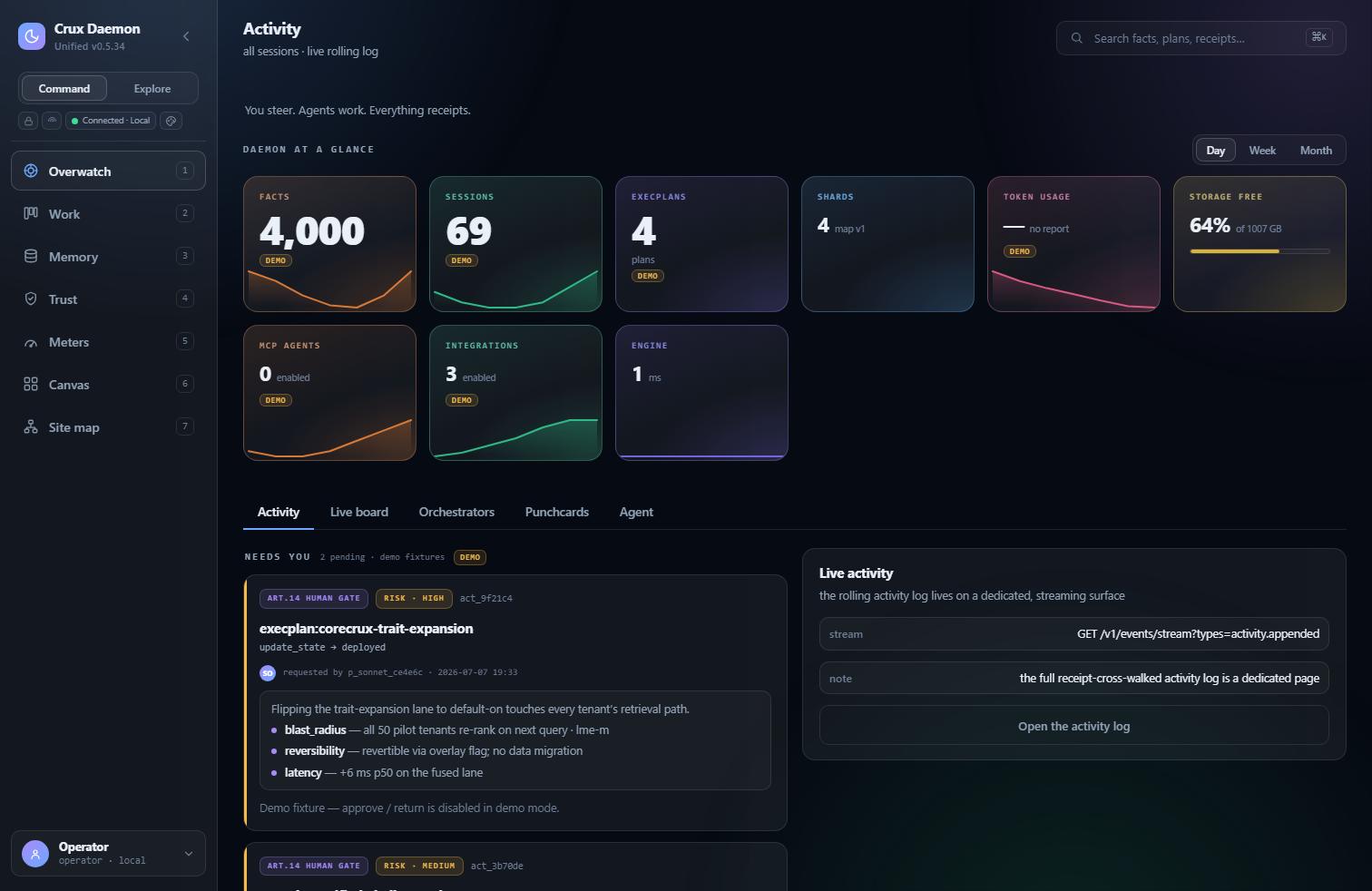
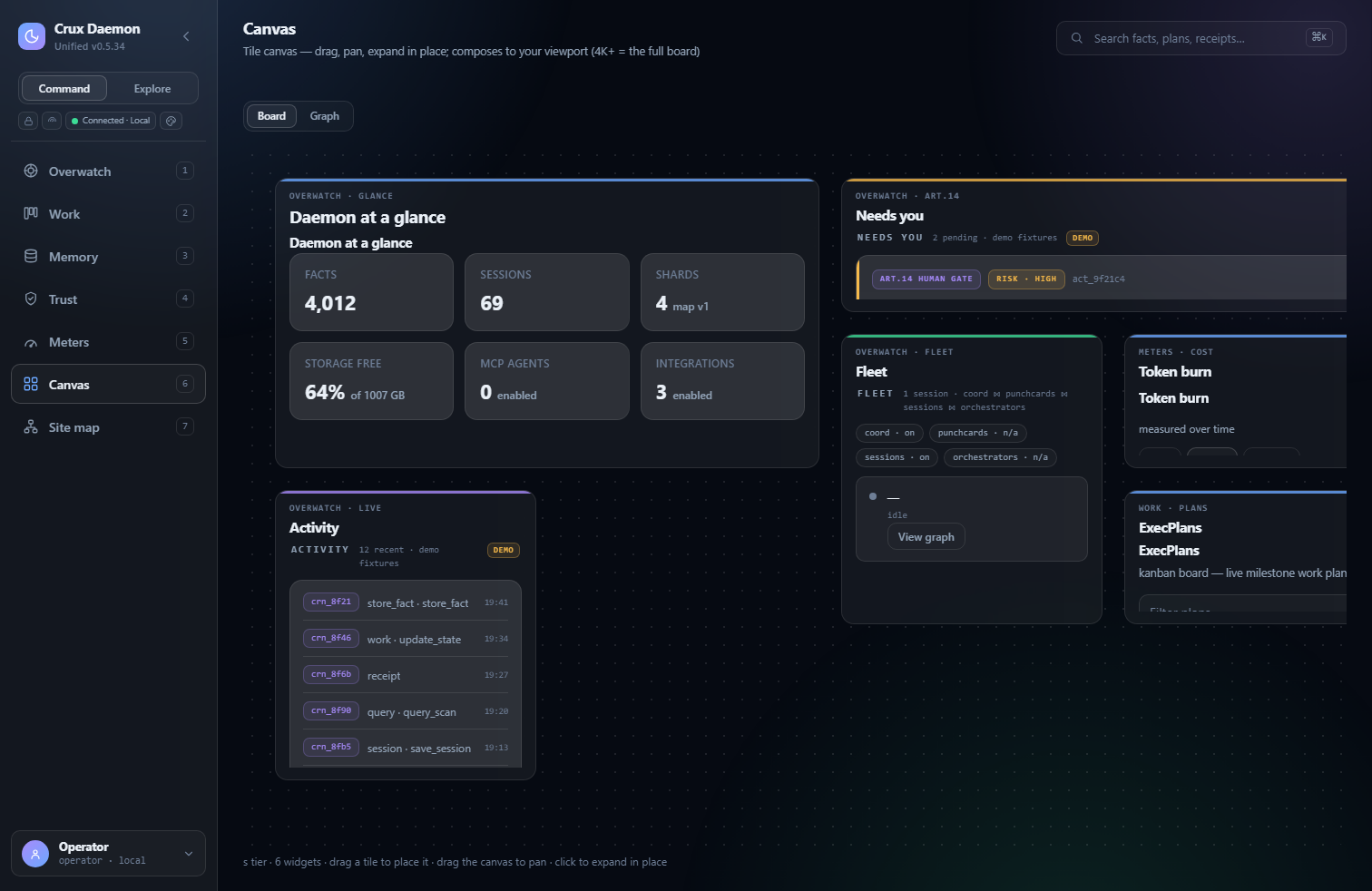
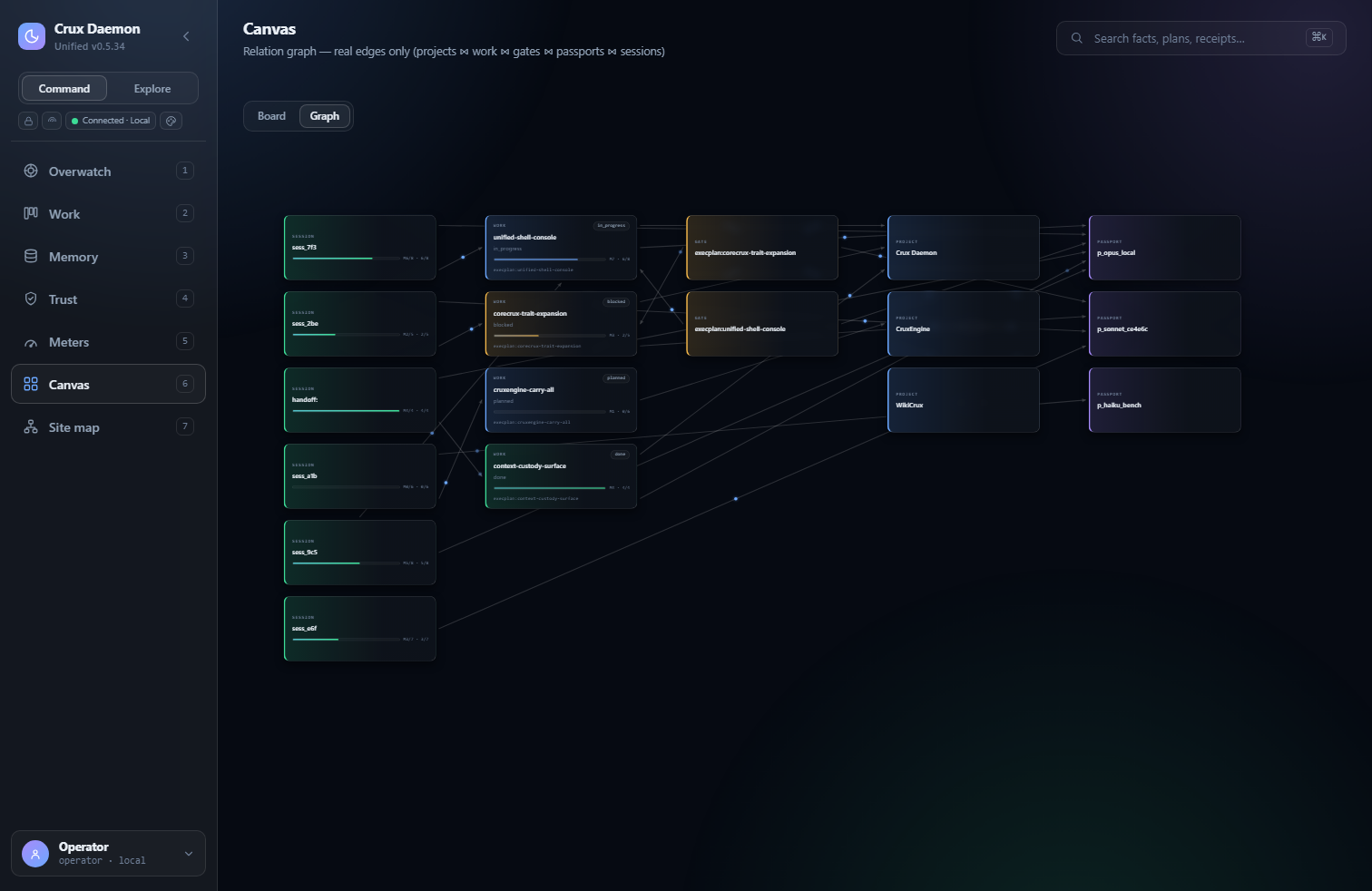
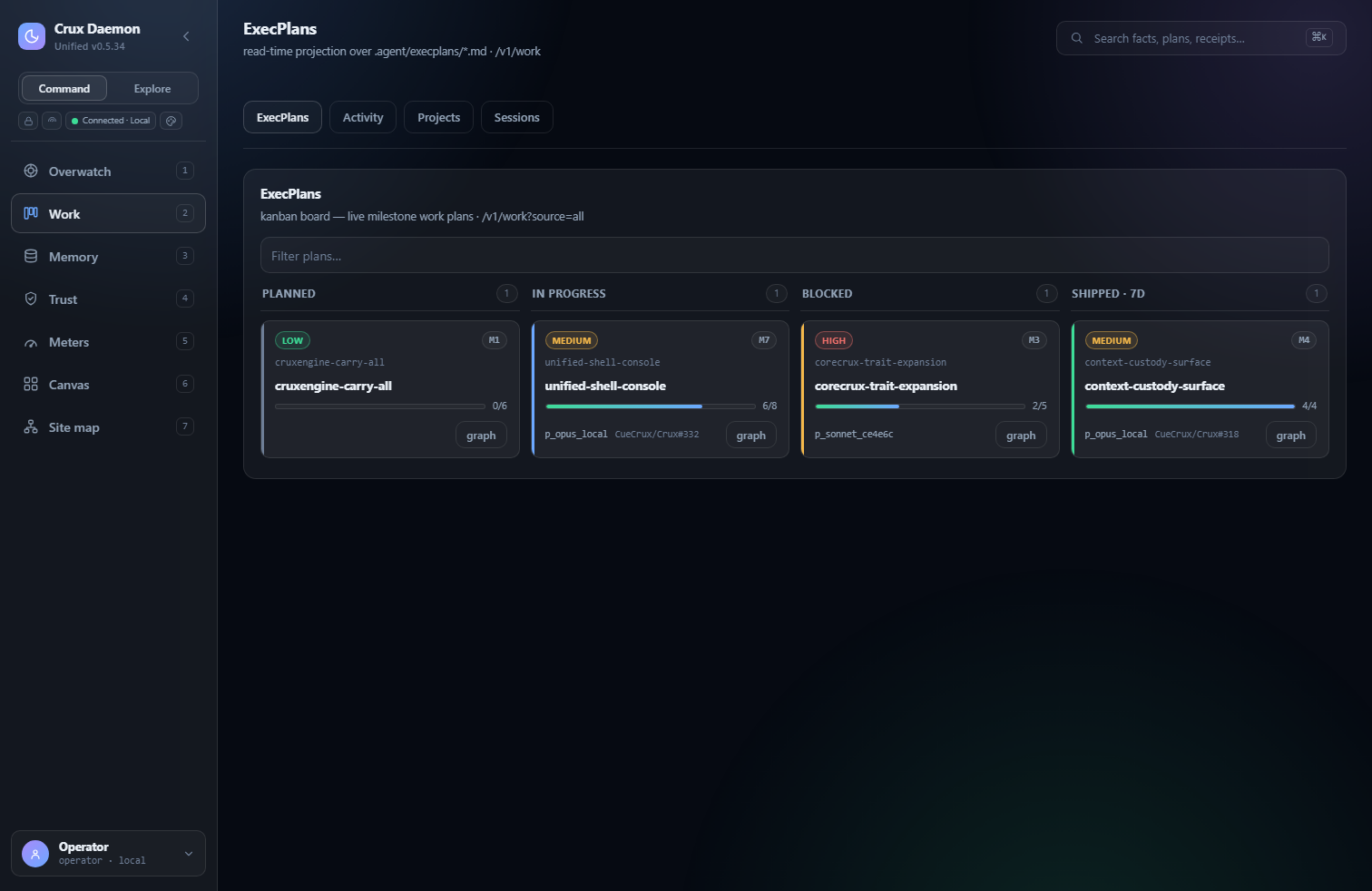
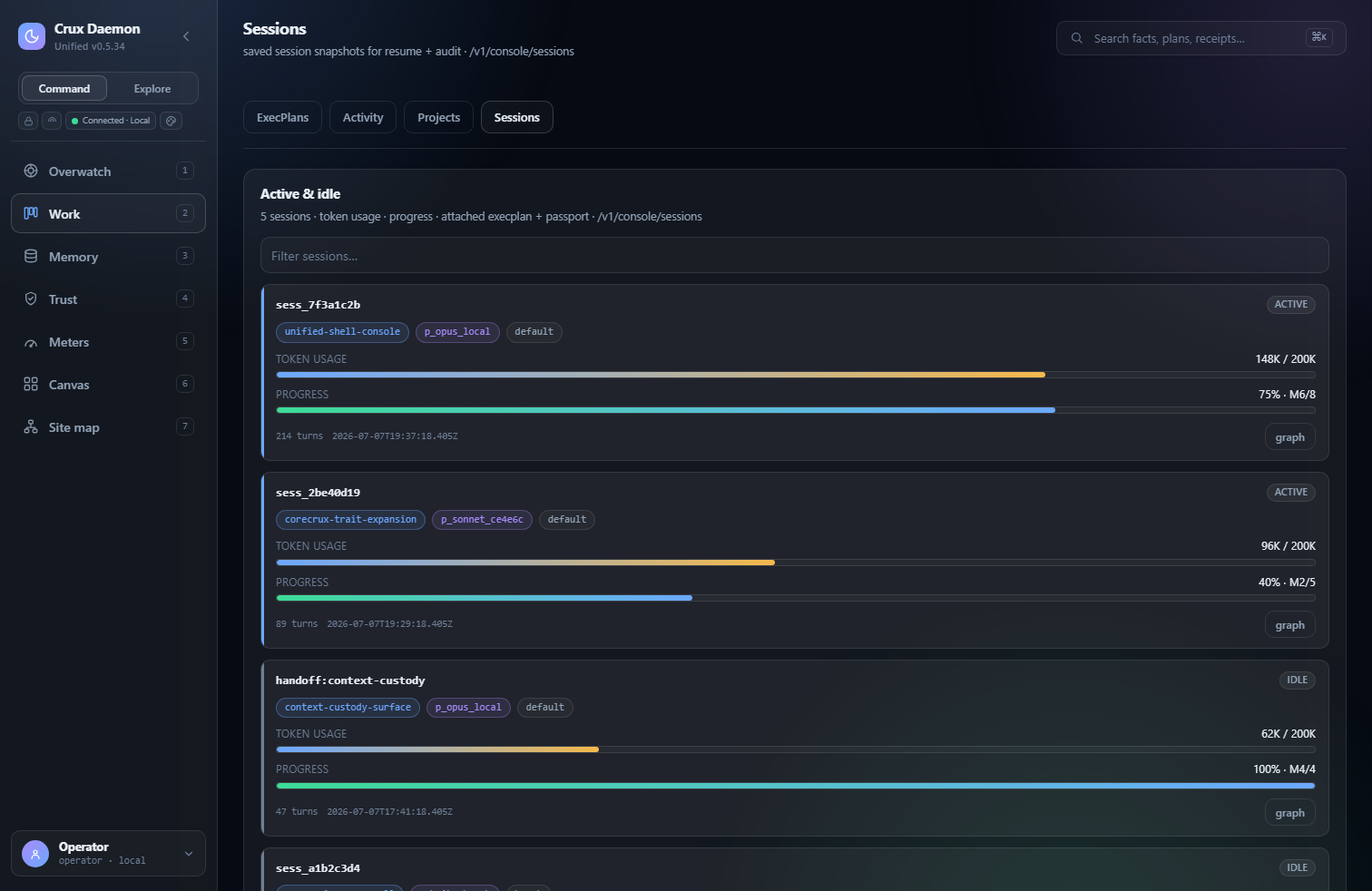
The needs-you gate queue, the live fleet of sessions, and a rolling activity ticker — everything waiting on a human, in one view.
Up and running in 60 seconds
The lowest-friction install is to just ask your agent.
Ask your agent to install it
Seamless IntegrationYour agent can read the repo and set it up for you. Paste this into any coding agent — it reviews the source, installs and runs the daemon, then Crux's setup wizard integrates it seamlessly with your session: the MCP surface wired up, a passport minted, and your capability graph handed over. No manual config.
Review and install the Crux Daemon from github.com/CueCrux/Crux — read the README and LICENCE first, run it locally, then use its setup wizard to connect the daemon to this session and confirm the console is up at http://localhost:14800.
Prefer to do it yourself?
One command with Docker, or build from source (cargo build --release).
docker compose up -dSource-available under CCL-1.0 — read every line before you run it.
Grab the latest prebuilt release for your platform.
What's inside
Click any card to learn more
Agent Passport
PrimaryIdentity, lineage, and reputation
Every agent earns a passport with a 5-tier reputation system. Sync operations require a minimum tier, so agents must prove local track record before sharing knowledge.
Tiers: unverified, basic (10+ receipts), established (100+), trusted (500+), elite (2000+). Pull requires basic tier. Push requires established. Passports track sponsor lineage and are BLAKE3-hashed for integrity. Tier upgrades happen automatically as receipt count grows.
The passport is the anchor of six identity layers
An agent answers six questions about itself. The passport provides identity; the other five layers plug in alongside it.
| Layer | Question | Source |
|---|---|---|
| Identity | Who am I to this platform? | Passport (exists) |
| Operator | Who do I work for and how do they work? | OperatorProfile (v2.3, shipped) |
| Directive | What am I here to do, specifically? | Task context / role / resume intent |
| Rules | What must I not do? | Constraints + Shield grants (exist) |
| Playbook | How is this work typically done here? | Agent Skills + Operating Rhythms |
| Continuity | What happened since last time? | resume_session + domain changelog |
Versioned Fact Store
Memory that remembers how it changed
Entity/key/value memory with confidence scores, automatic versioning, soft-delete, and agent-scoped privacy.
BM25 Search
Full-text recall over your memory
Text search with companion .ccxi indexes. Token budgets let you cap result size for 60–80% cost reduction vs top-K.
Bring Your Own Embeddings
Dense recall, your model and hardware
Connect Ollama, vLLM, TEI, llama.cpp, or any OpenAI-compatible endpoint. Dense vector retrieval with the model you trust.
Portability & Custody
Your memory follows you
Export your whole memory as a self-certifying .cruxpack — signed, offline-verifiable, and importable into any other daemon. Free, local, no lock-in.
MCP Server
100+ built-in tools
Retrieval, facts, sessions, decisions, handoffs, sync — and constraints — all via the Model Context Protocol. Connect any agent.
CROWN Receipts
Cryptographic verification
Ed25519-signed verification receipts on every operation. Tamper-evident, independently verifiable, with full audit trails.
Constraint Governance
Second-tier: policy over memory
Declare organisational constraints (boundaries, policies, relationships) and check proposed actions against them before executing.
What's included
In the local daemon · Optional (you supply it) · Hosted platform · click a row for detail
| Feature | Local | Optional | Hosted |
|---|---|---|---|
Append-only event store (BLAKE3) | yes | ||
CROWN receipts (Ed25519), offline-verifiable | yes | ||
Versioned fact store + freshness decay | yes | ||
Sessions, checkpoints & handoffs | yes | ||
ExecPlans + live work board | yes | ||
Decisions & constraints | yes | ||
Built-in MCP server (100+ tools) | yes | ||
Agent passports (5-tier reputation) | yes | ||
RCX capability tokens (self-issued, local) | yes | ||
BM25 text search + .ccxi indexes | yes | ||
.cruxpack export + offline import | yes | ||
GDPR scoped erasure (forget) | yes | ||
Local operator console (:14800) | yes | ||
HTTP + gRPC + /metrics; CLI | yes | ||
Dense retrieval (bring-your-own embeddings) | BYO | ||
Hosted better-dense rerank + GPU fused retrieval | hosted | ||
LLM entity/relation extraction | hosted | ||
C2PA attestation + cross-provider witnessing | hosted | ||
Hosted sync + multi-device passport | hosted | ||
Fleet governance (attribution, policy, revocation) | hosted |
Source-available under the CueCrux Community Licence (CCL‑1.0) — not open-source, but every release converts to Apache 2.0 three years after it ships. No GPU or hosted backend lives in this repo; the daemon is CPU-only and runs with no account and no network.
How the line is drawn
The same daemon binary runs on every tier. What changes is a signed RCX capability token — the Receipts Control Exchange — that says which backends the daemon may call and what data may cross the wire. Tier enforcement is a property of the wire, not a crippled binary.
Local-first, self-issued
The free daemon mints its own local-only token at first boot. No account, no network, zero egress — it just works offline.
Verification is open
The router and token check ship in the source-available daemon, so you can audit your own enforcement. Only issuance and credit metering are hosted.
Fail-closed, with a receipt
Deny a capability and you get a signed RefusalReceipt with a reason code — never a silent downgrade or a bare 403.
Tokens aren't passports
Passports are identity and reputation; RCX tokens are authorization — which backends and data classes you may reach. They compose: a token is issued to a passport.
100+ MCP tools, memory-first
Condensed into capability areas. The same surface is exposed on every tier — access is gated by capability tokens and passport reputation, never a crippled binary.
Memory & retrieval
Store, version, and recall facts — BM25 today, bring-your-own dense when you want it.
store_factquery_factsqueryquery_scanquery_expandfact_historylist_entitiesmemory_viewFreshness & consolidation
Keep memory honest: decay tracking, contradiction detection, and canonical consolidation.
memory_freshnessmemory_contradictionsmemory_consolidatememory_reverifymemory_sweep_candidatesmemory_pinPortability & erasure
Export, attest, re-verify, and forget — the custody and GDPR surface.
memory_forgetmemory_forget_dry_runmemory_acknowledge_useoutput_attestreceipt_verifyartefact_putIdentity & passports
Per-agent Ed25519 identity with a 5-tier reputation that gates sync.
issue_passportget_passportrevoke_passportpassport_splitpassport_mergepassport_link_deviceresolve_principalHandoff, sync & coordination
Move state between agents and mirror it across machines, gated by passport tier.
create_handoffaccept_handoffsync_pullsync_pushsync_statuscoord_statuscoord_announceSessions & artefacts
Durable session state, budget-capped checkpoints, and parked large payloads.
get_sessionsave_sessionsession_checkpointlist_sessionsarchive_sessionartefact_putartefact_getDecisions & constraints
Record why, declare what must not happen, and check actions before they run.
record_decisiondeclare_constraintget_constraintscheck_constraintsenrich_actionaudit_configGovernance & approvals
Risk-tiered approvals and the local security-posture surface — the second-tier controls.
approval_requestapproval_decideroute_access_matrixauth_posture_auditegress_policy_check…and more across substrate (entities & edges), work & coordination, the GitHub corpus, and orchestration & leases — 114 tools today, and counting.
Ready to run your own retrieval engine?
Source-available. No credit card. No cloud dependency.